
NLMUSD approves superintendent amid bond controversy
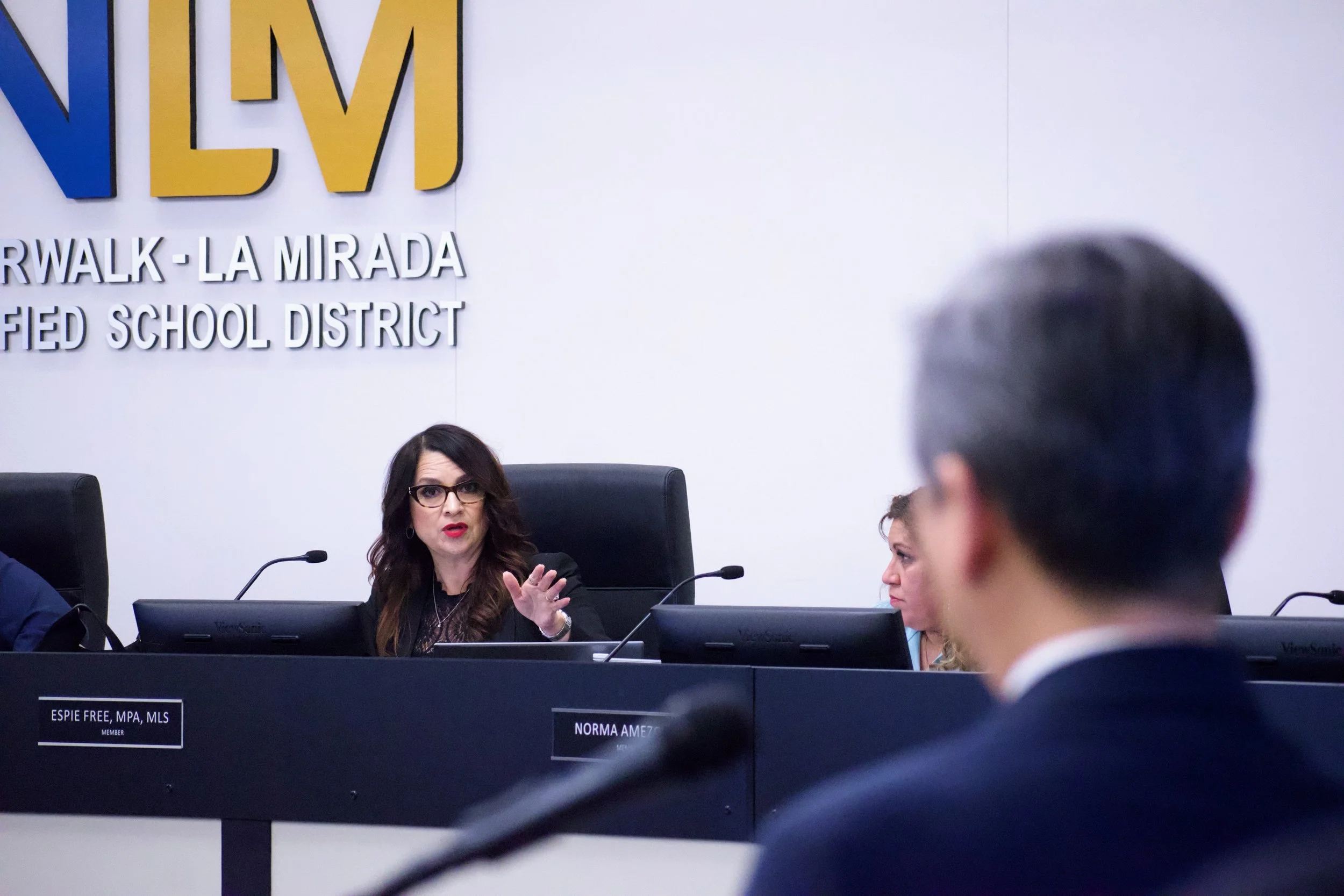
Tania Magaña (center) is appointed superintendent of Norwalk la Mirada Unified School District by the Board of Education on Monday, May 18, 2026. (Photo by Vincent Medina)
NORWALK — A tense, pointed discussion ensued between school board trustees and district bond consultants regarding Measure G financing, amid the appointment of a new Superintendent and the review of the new district cell-phone policy.
The Norwalk-La Mirada Unified Board of Education meeting extended until around midnight Monday, after heated exchanges from trustees and staff over how the district communicated details of the recent Measure G bond sale. The board also unanimously approved a new superintendent and held the first reading of a district policy that would significantly restrict student cell phone use during the school day.
Measure G
The Board of Education President Robert Cancio and trustee Espie Free pressed the district’s outside bond consultants and staff over a $20 million Series G bond issuance under Measure G and a potential refinancing of older bonds that was ultimately not completed.
“I watched the videos from November (study session) and went over everything you said, all the presentations, and I still do not believe that it was clearly communicated not only to the board, but to the public on these two separate transactions,” Free said.
The district had considered refinancing some older Measure G bonds to generate taxpayer savings, and consultants had brought two separate resolutions to the board in December 2025 for approval, according to Jin Kim, bond underwriter and director of educational facilities financing from Bank of America.
While the new $20 million bond issuance went forward, the refinancing was ultimately not completed because interest rates did not produce meaningful savings, according to Kim’s presentation.
Free raised repeated concerns that the board and the public were not adequately informed that the December 2025 approvals involved two separate transactions, one for new borrowing and another for potential refinancing. She said the November presentation focused heavily on refinancing and taxpayer savings, while the new debt component received less emphasis.
“Let’s go back to Nov. 17, you (Kim) came with the presentation and it was framed as a refinancing,” Free said. “The narrative centered was on monitoring for taxpayer savings through refinancing. The proposed $20 million Series G new money issuance was listed on the table on the side, but the overall framing title emphasized on the presentation were refinancing and savings and not taking on new debt.”
Free questioned why the district only provided one offering document, believing the Preliminary Official Statement required separate documents for the new money issuance and the refunding (refinancing) portion rather than combining everything into one document.
She argued that the consultants had not been transparent because one combined document was provided for the new $20 million issuance and the potential refinancing.
Free accused the consultants of downplaying the new bond money issuance and said the board was not given the proper information to make an informed decision.
Bond legal counsel Nicholas Heuer clarified that it was always intended to be one combined offering document. He said both resolutions approved the form of the same Preliminary Official Statement. When the refinancing fell through due to not generating enough savings, the refunding portion was removed from the document and only the Series G bonds were marketed under that same official statement.
He clarified that there was never a plan to have two separate offering documents. It was structured as one combined POS from the start.
Despite Heuer’s explanation, Free continued to argue that the consultants had not been transparent about the new money issuance.
“You don’t get to sneak in a resolution and then say, ‘oh well, we brought it to you,’” Free said. “We relied, we trusted that you were giving us the proper information to make an informed decision. Had you presented the new money issuance with all the information that we know now, I would have voted no against it, because I’m not voting for a greater taxpayer liability. We were told that it was going to be a tax taxpayer savings when we refinanced, that was the narrative.”
Kim maintained the consultants were clear from the Nov. 17 study session onward about both the new $20 million bond draw and the potential refinancing of old Measure G bonds, being conditional on generating savings.
“On Dec. 8, we brought forth two separate sets of resolutions, and those resolutions clearly identify the Series G bond issuance for $20 million and a potential 2026 refunding bonds for taxpayer savings,” Kim said. “In January, we shared information with the board that because of where interest rates are now, after evaluating further, the refinancings currently do not generate any savings for the taxpayers, so therefore it would not be in the best interest for the district to proceed.”
Free criticized the quality of documents provided after the bond sale, noting the closing memorandum she and interim Superintendent Tania Magana received contained missing pages and was out of order, saying, “This was no error.”
Free highlighted the memorandum, which also still listed former Superintendent Natasha Baker, after Baker had resigned.
Free also noted that the memorandum official statement read that the signature block for the district will be revised and replaced with Assistant Superintendent Estuardo Santillane. The signature block should be the name of the interim Superintendent, Free said.
Heuer explained that compiling the full closing transcript after a bond sale typically takes two to four weeks. He explained that the documents provided to Free and Magana were only those immediately available at the time. He said that many items listed in the closing index — including the official statement and legal opinions — are often delivered as part of the final transcript at a later date.
The Measure G discussion extended to a board resolution that delegated authority over the $20 million project to then-Superintendent Baker. After Baker’s resignation, Assistant Superintendent Santillane said he began making decisions for the project and that the former superintendent delegated authority to him.
However, President Canico argued that because Baker is no longer with the district, she cannot delegate authority to anyone.
“I voted against this (resolution) back when it came forward, but there was never any conversation about delegated authority, even in the absence of the presence of the individual,” Cancio said. “That's grossly inappropriate. The individual is not here, they don't get to delegate any authority.”
Trustee Narcis Brasov, who was board president at the time the resolution was passed, said he understood the resolution to mean that authority was designated to the office of the Superintendent.
Trustee Free pointed out that, if the authority is connected to the office, it would be designated to interim Superintendent Magana, and Santillane may have acted without proper authority.
“We need to review everything that you've done,” Free said. “All the decisions that you've made under that authority that you were never given by the board.”
Magana said that when she was appointed interim Superintendent, she did sign for the $20 million to be approved, and is still learning the legal implications.
Free finished her remarks by calling for a full forensic audit of all Measure G bond issuances, arguing that the board was not given complete information during the bond process and said the district should examine past bond activity to ensure there were no broader issues with transparency or oversight.
“Everything from the beginning of Measure G needs to be audited and investigated, maybe starting with this board all board members, who have served,” Free said. “I do recommend that we do a forensic audit on Measure G, the contracts, everything, because I believe we weren't fully informed, and if it happened this one time it is most likely because they've happened before.”
Cancio reminded Free of the board’s existing Measure G committee, and it would be up to their discretion to examine the issues further. He said if the committee chooses to review the matter, their recommendations would come back to the full board.
New Superintendent
Tania Magaña was unanimously approved as the new NLMUSD Superintendent, after serving in the interim capacity following the resignation of former Superintendent Natasha Baker in February.
Magaña has been with the district for 11 years, starting as a math and science teacher at Los Alisos Middle School in 2016. She would work as the assistant principal, then principal at the middle school, before starting as the assistant Superintendent in July 2025.
Magaña said she has developed familiarity and trust with community members and parents in the district.
“ I'm excited about the opportunity to implement programs that we have found that benefit students academically, socially and emotionally,” Magaña said. “Some of the key areas are collaboration with all the union partner teachers, our staff and just bringing people together again so we can move the work forward.”
Trustee Mark Copeland spoke positively about Magaña’s visibility across the district. During his board communication, he noted that Magaña had accompanied him on school visits and he saw the relationship she built with district staff and students.
“Superintendent Tania Magaña was a celebrity everywhere we went,” Copeland said. “Everyone was excited to see her.”
Magaña will begin her formal four-year superintendent term on July 1.
The board also approved Magaña’s Superintendent employment contract, with the duration lasting between July 1, 2026, and June 30, 2030. Under the contract, Magaña will receive a base salary of $310,000 per year, and management benefits that include 25 vacation days annually, 12 sick days per year, health and welfare benefits and a $650 monthly automobile allowance.
The contract also provides for a $1,000 annual stipend if she holds an earned doctorate and includes provisions for professional development, including executive coaching during her first year. It contains standard termination clauses, including a provision allowing the board to end the agreement without cause with 60 days’ notice, in which case she would receive up to 12 months of severance pay.
Magaña’s appointment comes after the resignation of former Superintendent Natasha Baker during a special board of education meeting on Feb. 11.
"On behalf of the Board of Education, I would like to thank Dr. Baker for her service to Norwalk-La Mirada and wish her well in her future endeavours," wrote Board President Cancio at the time. "Our focus as a Board is on the next leader for our amazing District, and we will communicate that process to our community in due time."
There were no further details about her reason for resignation.
District Cellphone Policy
The districtwide cellphone ban policy initial reading, drew public comment from students and teachers concerned about the strictness of the proposed rule.
Trustees unanimously approved the first reading of the policy, but also agreed they want more feedback from district student and parent committees before the second reading of the policy.
The proposed policy would prohibit K-12 students from using their cellphones and other devices throughout the entire school day, not just during class time.
Under the policy, cell phones, smartwatches, earbuds, headphones, tablets and gaming devices would not be permitted during school hours. The only exceptions would apply to devices required by a student’s Individualized Education Program (IEP), Section 504 plan, or for documented medical necessity.
If students violate the policy, A first offense would result in confiscation of the device, with it returned to the student at the end of the day. Subsequent offenses would require parent or guardian involvement, and repeated violations could lead to devices being held for several days, along with additional school consequences such as detention or loss of privileges.
More serious violations, including recording others without consent, using devices in restrooms or locker rooms, cyberbullying, or academic dishonesty, would result in immediate escalation and could lead to suspension.
During public comment, several speakers raised concerns about the scope of the proposed ban. Veronica Rodriguez, a junior at Norwalk High School, said she supported restrictions during class time but opposed a full-day prohibition.
“I believe this will actually result in an even larger issue,” Rodriguez said. “It isn’t logical to have the teachers and staff put their focus on enforcing this policy, making sure that thousands of students in each school are not using their phone from the start till the end of school.”
She also noted that many students use phones for legitimate purposes, such as uploading assignments and accessing educational content that is blocked by school wifi, and urged the board to consider a policy that allows responsible use during lunch and passing periods.
Norwalk High School social studies teacher Kate Wilson, who has worked in the district since 1996, expressed concern that a zero-tolerance approach to cellphones would remove a necessary tool for students and teachers. She read what school-related uses her students say they might use their phones for during school.
“Students use phones for legitimate educational purposes,” Wilson said. “These are what I got from my students. Legitimate reasons: they upload assignments to Schoology, the camera on the Chromebook is not effective for that. The district’s firewall on the computer blocks almost everything, so if they want to find a picture to put into a project, they have to use their cell phone. They scan QR codes to meet with their counselors and to meet with the Wellness specialists. A lot of our campus activities, including ASB, Link Crew, athletics, clubs, performing arts, use the Remind app so that students know what’s going on.”
Board members acknowledged the concerns raised during public comment but emphasized the need for consistency across all school sites. Trustee Jose Rios, who serves on the Policy Committee, noted that feedback from the community and staff repeatedly highlighted inconsistent enforcement as a major problem under the current approach.
Rios also pointed out that many surrounding districts, including Downey, Fullerton, and Whittier, permit cell phone use outside of class time at the high school level, while Los Angeles Unified has adopted a stricter full-day ban.
Cancio stressed the importance of clear rules and accountability.
“So whatever policy it is, if it’s going to be nothing at all or semi, you know, we have to make sure that we hold every admin accountable to make sure that they execute and they support their team 100%,” Cancio said.
The policy was approved for first reading with a unanimous 7-0 vote. A second reading is expected at a future meeting. Under state law, districts must have a cell phone policy in place by July 1, 2026.